The subcamps of the Flossenbürg concentration camp and their aftermath
Conference, October 26 – 28, 2026
Call for Papers
Deadline: July 15, 2026
Abstract: max 1,500 characters
Contact: and
Confrence venue: Flossenbürg Concentration Camp Memorial and Regensburg
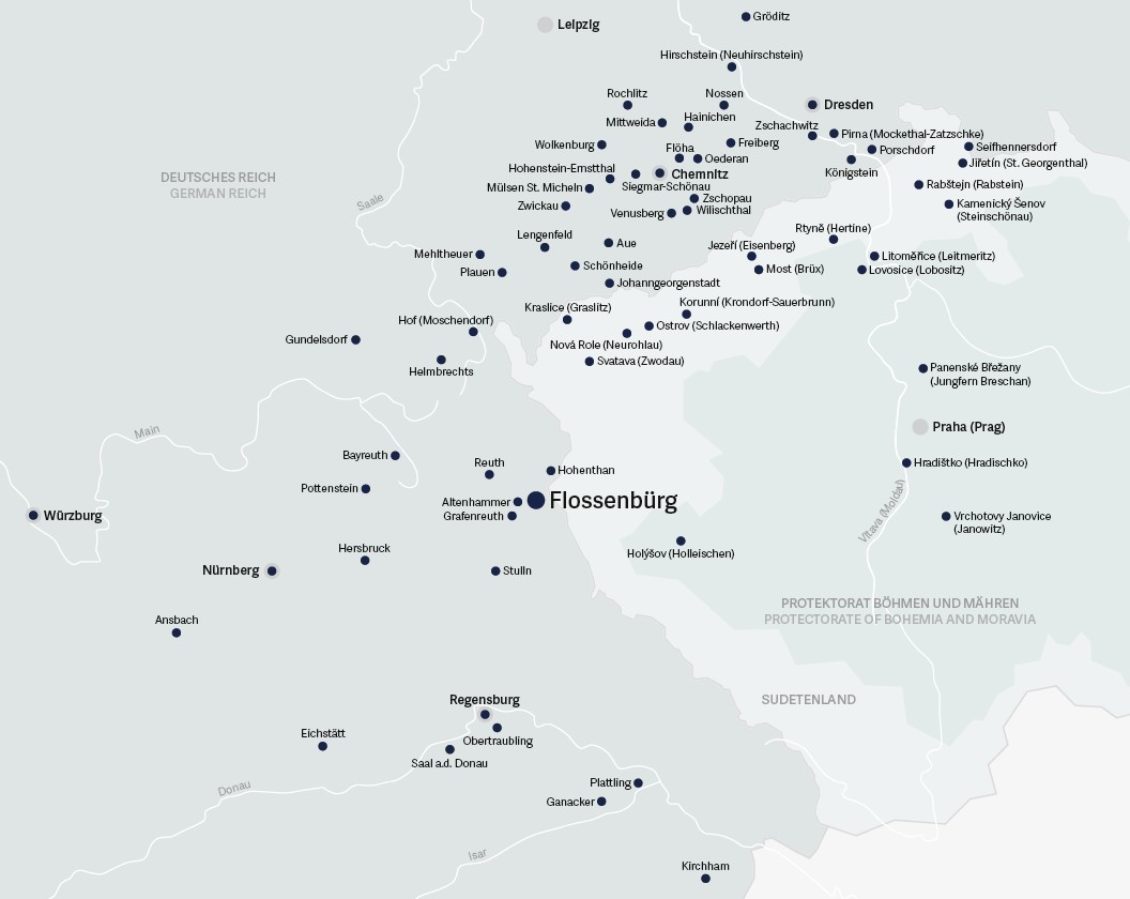
Between 2005 and 2009, the nine-volume encyclopaedia series Der Ort des Terrors. Geschichte der nationalsozialistischen Konzentrationslager (The Place of Terror. History of the National Socialist Concentration Camps) was published. It is still one of the most essential works on the numerous sites of the National socialist concentration camp system. The series, edited by Wolfgang Benz and Barbara Distel provided fundamental impetus for recent research focusing on “forgotten” and supposedly unknown Nazi crime sites or forced labour camps. This applies in particular to the often peripherally situated sites of the concentration camp subcamps. Twenty years after the publication of the fourth volume, which focuses on the Flossenbürg concentration camp complex and its nearly 80 subcamps, it is time to once again turn our attention to its extensive network of subcamps, which, between 1943 and 1945 stretched across large parts of Bavaria, Saxony and the present-day Czech Republic.
The decentralised system of the Flossenbürg subcamps was fragmented and varied in its functions. Male and female prisoners had to carry out a wide variety of forms of forced labour. They were housed and provided for in various ways near their workplaces; the duration of their existence and size varied considerably. At the same time, subcamps were often established in the centre of towns and municipalities, meaning that in the final year of the war, the concentration camp system increasingly permeated the everyday life, consciousness and social environment of the German societies – in both rural and urban areas. Interaction was inevitable. At sites of forced labour, the prisoners were subjected to a wide range of working and living conditions; serving as scenes of violent Nazi crimes, these sites were in many cases also the final destination of their experiences of persecution – which in some cases had lasted for several years – through prisons, ghettos and camps across occupied Europe. During the final months of the war, the subcamps became both the destination and departure points for death marches and transports – many prisoners did not survive. Their graves along these routes fell into oblivion, were dissolved or remained unknown.
The Flossenbürg Concentration Camp Memorial would like to critically re-evaluate the subcamp system and aims to consolidate the knowledge – which is at times fragmentary and scattered – along with the research findings of the past twenty years. We welcome not only microhistorical contributions that shed light on the diverse sites and facets of the Flossenbürg camp complex. Potential thematic focal points may relate to the following topics or address further aspects:
Neighbourhood
Concentration camp prisoners were visible at the respective sites of subcamps. Contrary to widespread postwar belief they were also perceived by the local population. Which kind of dynamics existed between concentration camp prisoners, (local) civilian workers, other groups of forced labourers, guards or the local civilian population? Which consequences did these interactions have, and how are they documents, passed on and remembered?
In addition, local structures were essential in order to enable the existence of a subcamp. Local suppliers provided the subcamps with goods; SS guard detachments were housed in existing accommodations; and authorities approved construction projects or were involved in the disposal of the dead – some of whom rest to this day in municipal or church cemeteries. We invite contributors to examine these administrative, social, and / or economic interconnections through the lens of specific case studies.
Forms of Perpetration
In the final year of the war, the growing number of prisoners and the expansion of the concentration camp system – including subcamps – were interlinked. At the same time, a profound transformation of the SS guard units took place in order to meet the (increasing) demand for personnel. In the final year of the war, the camp SS was not a homogeneous force: long-serving SS men encountered female SS guards, Wehrmacht soldiers, “foreign auxiliaries”, and “ethnic German SS volunteers”. Which experiences – particularly in regard to violence and the exercise of violence – did the new groups joining the concentration camp guard service from 1943/44 onwards bring with them? How did the diversity of the guards affect the unit and the guard service itself? Which impact did these changes in personnel have on the living conditions of the concentration camp prisoners? Can gender-specific characteristics be observed?
Prisoners were forced to perform various types of labour in the subcamps. Civilian personnel coordinated the forced labour in close cooperation with the SS. Contributions that broaden the concept of perpetration and, among other things, explore its intersections with the Nazi war economy or the local civilian population – are welcome. How, for instance, did the “deployment” of concentration camp prisoners in the armaments industry impact a specific “workplace community”? Did the division of labour lead to tensions between a company and the SS? In which Nazi crimes did civilian personnel participate in? Were civilian perpetrators or members of the SS held criminally accountable after 1945?
Aftermath
After the end of the war, simply resuming a “normal” life was not possible for many former prisoners. Years of exclusion, captivity, and forced labour had left their marks. What became of the prisoners after their “liberation“? What strategies did they develop to cope with what they had endured? What role, specifically, did subcamps play – both in individual memories and in post war trials?
For the rest of the society, too, there was no such thing as an often-invoked “zero hour”. In many cases, subcamps had been situated right in the middle of a town, visible to the local population. How did they deal with former sites of forced labour and the Nazi atrocities? How were the camps repurposed, repressed or built over? How did the approach to these sites differ across the German Democratic Republic (GDR), the Federal Republic of Germany and Czechoslovakia? What narratives emerged regarding their own (non-)involvement? How did society deal with the countless number of dead? How – and who – commemorated them, if at all?
Remembrance
The subcamps of Flossenbürg concentration camp were as diverse as the way in which they have been and continue to be remembered. While many sites have fallen into oblivion, others have been repurposed, built over, or – in some cases – politically instrumentalised.
We want to take a look at the period from 1945 to the present day and ask which practices of commemoration and remembrance have been and continue to be “successful“. Which places of remembrance reach people and stimulate discussion and exchange? To what extent can local communities be involved?
Which actors – from politicians and businesses to civil society – have played and continue to play a role in the development of local memorial sites and concepts of remembrance? What challenges arise in the care and development of memorial sites and educational programmes? And how are the relatives of former concentration camp prisoners supported for and involved at the sites of former subcamps?
We would be delighted if you were interested in taking part in the interdisciplinary workshop with a 20-minute presentation (in German or English). The conference will take place from 26 October 2026 to 28 October 2026 at the Flossenbürg Concentration Camp Memorial and Regensburg. The workshop will include an excursion.
Please send your proposal in the form of an abstract (max. 1,500 characters) together with a short CV by 15 July 2026 to Laura Lopez Mras and / or Maximilian Schulz:
Travel costs (train fare, 2nd class), accommodation and meals will be covered. We aim to publish the papers in an anthology.