Newsletter 04/2026
On this page, you will find all extended articles created for the April 2026 newsletter.
The focus is on the emotions and reflections through which former prisoners of the Flossenbürg concentration camp look back on their own liberation.
Do you have any suggestions or requests regarding the newsletter?
newsletter@gedenkstaette-flossenbuerg.de
threshold situation of liberation
“…and that is why I cannot relate to the term liberation”
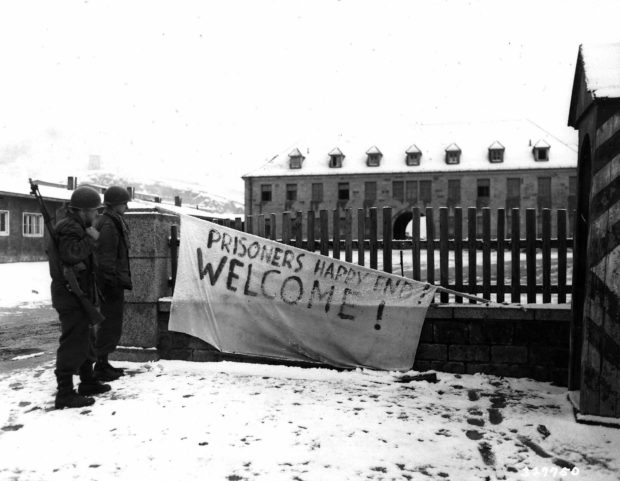
The discovery of the Flossenbürg main camp by U.S. Army troops on 23 April 1945 serves today as the reference point for the “liberation” of the concentration camp and also shapes the annual commemorative ceremony. In reality, however, the camp complex, with its main camp and around 80 subcamps, had already begun to dissolve from mid-April, when the SS forced thousands of prisoners on death marches. Many were murdered in the process, while for others their suffering was prolonged—for example, the Flossenbürg subcamp Leitmeritz remained under SS control until 8 May 1945.
Emil Lešák, a politically persecuted Czech, experienced the arrival of U.S. troops in the main camp: full of energy, he had already begun writing a testimonial account and rushed toward his liberators in euphoria. Anna Mettbach, quoted at the beginning, makes clear that the end of National Socialist persecution did not mean a true end to exclusion and persecution for everyone. She reports on her experiences of discrimination as a Sinti woman even after 1945.
There was therefore no single “liberation.” The end of the Flossenbürg camp complex was an individual experience for each prisoner and was marked by sometimes contradictory emotions. For many survivors, a period of profound uncertainty began after imprisonment. War and persecution had destroyed homes, families, and social environments. The following seeks to approach this “threshold situation of liberation” through such experiences.

Physical exhaustion
Most prisoners were in such a severely deteriorated physical and psychological condition at the end of their imprisonment that, in the main camp alone, around 150 people died after the arrival of the U.S. Army. Many prisoners liberated on the death marches also died from starvation or exhaustion.
The Italian Vittore Bocchetta managed to escape from a death march beginning from the Hersbruck subcamp. Aimless and close to dying of hunger, he struggled on until he reached a prisoner-of-war camp, where he collapsed at the gates. The British internees there, who were in a comparatively better material situation, washed the unconscious prisoner and were able to care for him.
Shelomo Selinger survived in May 1945 only because of the independent actions of a Red Army soldier. The 16-year-old, who had been persecuted as a Polish Jew, was so physically exhausted after a death march from a subcamp near Dresden that, in the now liberated Theresienstadt, he was presumed dead and placed among the corpses. The soldier who noticed his faint signs of life had him treated in a military hospital, likely without authorization.
The struggle for survival thus continued even after liberation, for many in a situation of complete helplessness and dependence on others.

drive and joy
“I must interrupt now, the liberators are here!!!!!!” — this is how the Czech journalist Emil Lešák recorded the arrival of the Americans in Flossenbürg on 23 April 1945 in his report. Lešák had begun writing the report the evening before and ultimately produced twenty pages about his imprisonment in the Flossenbürg concentration camp since August 1942.
Due to his knowledge of German, he had been assigned a functionary position in the camp, with lighter work and better rations. As a result, he was also in a better physical condition than many other liberated prisoners. He immediately used these resources to bear witness. He deliberately wrote in German in order to make his report usable as evidence.
uncertainty
Jack Terry, who was still known as Jakub Szabmacher when he was liberated in the main camp, described the liberation as the saddest day of his life. It forced him to confront what his life would be after the war: he was 15 years old, and his entire family had been murdered by the National Socialists. He was alone. What was he supposed to do now?
The world had changed: borders had shifted, and the war and Nazi terror had devastated cities and regions, wiped out entire families, and deported hundreds of thousands. For many, there was nothing left to return to. Former concentration camp prisoners became so-called “DPs” — Displaced Persons. Camps were once again established for them, where some remained for years after the end of the war. A DP camp was also set up in 1947 at the site of the former Flossenbürg main camp.

Long-term effects
Shortly after his liberation, Shelomo Selinger suffered from amnesia and was unable to recall his camp experiences for seven years—a protective mechanism the body uses to process trauma. Later, he explored his concentration camp imprisonment through art, as did Vittore Bocchetta. The trauma, however, remained—for the rest of there life.
Anna Mettbach, a German Sinte woman who survived the death march from the Wolkenburg satellite camp to Dachau, says of this: “These are images that constantly haunt me. And that is why I cannot relate to the word ‘liberation.’ It is ever-present. It was not the prisoner who was liberated, but the camp from the prisoner.”
